About Me

My photo
I am a mother, a teacher, and a nature lover. I grew up on a mountain we called Owls' Knob in the Ozarks of Arkansas. The first seven years of my life were spent living in a log cabin, far from a store or streetlight, without electricity or running water and after twenty years of travel, I returned to the abondoned homestead. Now I live on a hill by a small lake and work at a public garden. These are stories about nature written from a women deeply influenced by place.

Saturday, June 22, 2013

Super Strawberry Summer Solstice Moon

Now all is quite, the children are asleep, only the moon is up with me. It is June; so it is a strawberry moon. The days are long and the nights are short. The longest day is upon us. The solstice, the first day of summer. The largest moon is also here. Each year the moon drifts further away and then closer to the earth as it orbits. Tonight it is at its closest point for 2013. Though this happens yearly, it coincides less often with the full moon and the solstice. But regardless of the moon, this summer night is special, simple because I have observed it as so.
The moon is brilliant tonight. Pregnant and leaning heavy towards the earth. I walk through the garden unhindered by the shadows, for the light of the moon can guide me where I wish. Moonbeams dance upon freshly watered squash and bean leaves. Thousands of spherical beads of crystalline light glisten among the foliage.
The air smells of citronella from torches still burning. At dusk they were lit to chase away the mosquitoes so my son could help me water the garden. After spraying the plants and himself for an hour, the sun sank away and the moon rose. Fireflies frolicked into the yard. I carefully caught a firefly in my hand and showed it to my four year old son. His eyes lit up. Magic. We proceeded to chase the fire flies around the yard calling them, "blinkers." I felt 12 all over again.
Now all is quite, he sleeps. Yet a few birds are calling. The mocking birds are chattering away.  Confused perhaps by the brightness of the moon, they think it is morning. Crickets also chirp their romantic mating song. No, it is not quite at all. But my mind is quite... And that is the quietness so hard to find and so special to hold.


Tuesday, June 11, 2013

In the Wind and the Willow Seeds

     Today along the river bank the willow seeds are emerging and the wind is setting them free. Clouds of fluffy white seeds drift past. It is snowing seeds. They collect on the shore and among the reeds but disapear if they touch the water, as if melting into it. The sun is hot but the breeze is refreshing... and filled with mystery, as if the willow seed haze is hiding something or someone. Perhaps it is hiding insects. It is a peaceful day for bugs. The flies, mosquitoes, and bees are not in this tranquil scene with all their buzzing about. Only dragonflies and damselflies swoop low across the river. At first I wonder what they are hunting. Then I see that hiding among the fog of seeds are mayflies. The wind not only released the willows, it is also carring the mayflies on the single most important day of their little life.
     Mayflies live their life underwater in rivers. They are aquatic creatures, darting between rocks, clinging to the stones you kick when you walk upstream. Then on this one special day, they break out of the drab exoskeloton as a dazzeling mayfly. They leave behind an ugly brown body for a shimmering one with wings but without mouth parts for they will not live long enough to need to feed. For one day they fly. They soar over the river and dance in the breeze high above the cold watery world that had been all they had known until now. On this day they find love and make love. These lovers sexual bodies intertwine and together they dance in the willow seed laden wind, high above the water. They live in pure ecstasy, as angels in heaven, as fairy folk in fern gully. Then they die. The male falls upon dry land, exhausted and weak. The female drops into the water letting her beautiful wings get pulling into the icey depths, sacrificing her spent but beautiful body to the fish. But just before the death takes her under, the majestic insect lays eggs, so that another generation can grow up to live life to its fullest for one amazing day!

Tuesday, May 14, 2013

Summer tanager

   When we moved to Fayetteville almost two years ago, there was a summer tanager nesting on a low hanging branch of the oak tree that hovered over the driveway. In the hustle and bustle of moving, the limb that had held the nest was cut. I worried that the summer tanager would not return now that the branch was gone. These beautiful little birds are not only gorgeous and musical, but they also eat bees and wasps. So they are beneficial to anyone who is allergic to these insects.
   The last spring I thought that I saw the tanager, but an ornothologist friend of mine said it must have been a cardinal because it was too early in the season for the migratory tanagers. They like warm weather, so they spend thier winters in Central and South America.
   Last week I saw a summer tanager on the woods beside my house. I am sure this time and I even got a photo...

Summer Tanager

The lovely red bird has return and I hope it is here to nest and to stay!

Saturday, May 4, 2013

Snow in May in the South

I think the term global warming has done a huge amount of damage to the envormentalist movement against climate change. The term climate change much better captures what we are experiencing. We are not just seeing hotter summers and more mild winters, but droughts, floods, cold snaps out of season, and heat waves out of place. Wednesday afternoon the temperature reached into the upper 80s, Thursday night it dropped to below freezing! It even snowed!


I enjoy a nice snow in January. But once the irises have bloomed, peach blossums have dropped, and lettuce is popping up, I do not wish to see any snow! The biggest problem with climate change, of any kind, is its affects on gardens and food production. We may not like seeing snow in May or dangerous heat waves in August, but our comfort is not an issue. However, if lettuce is frozen and dies in May and beans can not survive the heat and drought, what will we all eat!


In my garden, I avoid planting anything that is not freeze tolerant until after April 15th. In the past that seems to be a safe date to start assuming the freezing tempertures are behind us. By May we are often hoping the plants don't go to seed too early in the heat. Frost has never been an issue this late in the season in my lifetime. I had plenty of plants in my garden that would not tolerate the snow. Luckily, I watched the weather and knew the cold front was on its way. In fact, the weather application on my husbands phone woke me up several times throughout the night beeping and alerting me to the freeze watch that was in effect. Most of the plants I have above ground are tolerant to a light freeze, but I needed to covered my tomatoes, peppers, and delicate leafy greens.


This year I found a simple, cheap, and effective way to cover my vegetables. I built temporary, miniature hoop houses. I used a roll of thick old wire that had been sitting under leaves in my father's back yard. I cut my wire in big half circles (or more like 3/4 circles), their shape was already perfect for my minutes hoop house. I took the pieces of wire and poked the ends into the ground on either side of the garden bed. I could have bought clear plastic to cover the hoop houses, but instead I tried just using old bedsheets, since I had them lying around already. All season I left the hoops bridging the beds and just threw the sheets over them when there was a chance of a freeze. It was much easier than I would have thought and cost me nothing. Most importantly, it saved my little plants!
 
Do you have a garden?
How did it do in this unseasonably cold front?
Share your ideas for protecting your garden against spring frosts!

Thursday, May 2, 2013

Wildlife Surviving without Wilderness


Early in the morning, I can hear a rooster crowing. I know someone has a chicken flock nearby. Swarms of honey bees have been buzzing on the peach blossoms in my yard lately. I suspect the rooster and the bees may be part of the same farm. It intrigues me because even though my land is a mere third of an acre and is within city limits, I dream of having a few chickens and some bees. I don't believe it is too lofty a dream. However, there is so much wildlife in the woods behind and beside my house, I worry it would be a battle to keep chickens alive and bees hives safe.

My house is very near the edge of town, tucked up on the backside of Sequoia Mountain with all its wildlife. The family of red bellied woodpeckers have been busily eating insects found in the silver maple trees on the street. They are active and excited in springtime. I hope they can save the tree from whatever type of bore is killing these beautiful maple trees.

There is a fat, lazy raccoon who eats our dog food if we leave it out. Lately, we have been visited by a noisy fox. It barks in the woods near the stream with a pitch that sounds more like a large bird--a peacock or a turkey-- than a mammal. I suspect the howl is from a vixen looking for a mate or signaling her territory. Maybe a little of both.

Last night I heard a predator of the fox calling, the great horned owl. I awoke to the sound of the great horned owl, calling from the oak tree outside my window. I have not heard the owl since late last fall when he and his mate were calling back and forth to each other in the woods up the hill. The moonless, cloudy night did not let me see his huge shadow but I could hear him calling out the open window. His beautiful and haunting call was deep and foreboding. Perhaps he has been hunting the noisy fox. I wonder too if the presence of the owl has to do with the disruption I have observed in sharp shinned hawks.

Recently I have noticed that the pair of hawks who have been living in the woods beside our house have been searching for a new resting place. For weeks they spent every clear day calling back and forth to each other and circling the wooded areas around my house. Great horned owls do not make their own nest, they steal the nests of other birds, like hawks. So perhaps the owls moved into the hawk nest and chased them out. A have a hard time imagining owls as big as the great horned nesting in a home built by a hawk as tiny as the sharp-shinned. But then again it is just an idea, I have no proof.

I welcome all this wildlife. Even if it would make keeping domestic animals more difficult. It fact it makes it seem more appropriate. I wish all these animals had more wilderness to roam in, but it is encouraging that wildlife can survive without much true wilderness. These wild animals seem to be surviving in the woods on the fridge of the city. It all keeps me sane and reminds me that nature is never far away. It reminds me that wilderness holds wildlife, even if it is a very small plot of land.

... This was written on March 9th. I started having contractions and forgot to post it. Then the fox began yelping and the owl calling to remind me to publish these words.


Bumble Bee on a Peach Blossom

Monday, April 22, 2013

Mother Earth


“There is no word for ‘nature’ in my language," said Audrey Shenandoah, a member of the Onondaga clan, to Harvey Arder and Steve Wall who wrote the book Wisdomkeepers (1990). "Nature, in English, seems to refer to that which is separate from human beings. It is a distinction we don't recognize." I try not to recognize this distinction either; however, in the English language there are many words for nature such as the environment, the earth, the wilderness, the natural world, the ecosystem, and Gaia just to name a few. Many native and indigenous cultures used words that are roughly translated into English as Mother Earth.

The Mother Earth has been worshiped all over the world in almost every religion throughout history. She is marveled at by science. All life is dependent upon her. It is common knowledge that life feeds life and the Earth supports all forms of life. The complex cycles of air, water, soil, and food are taught in elementary school; however, we pollute the air, poison the water, abuse the soil, and modify the food. The fact that everything we do to anything on the planet will cycle back to us is often overlooked. People have grown to see themselves as separate from the rest of the complex world. This separateness has given people a superiority complex that allows them to destroy the Earth without believing it impacts their own body. Yet, science has proven this assumption false. It can not be denied that there is interconnectedness among all individual things.

Nevertheless, our very lifestyle sucks out her resources, poisons her veins, and pollutes her lungs. Often this abusive nature is recognized, but seldom is it comprehended as self-abuse. We are merely a small part of the great Mother Earth, who is simple yet complex and unified yet diverse. The Mother Earth is a composite organism made up of living beings, ecosystems, and elements, all of which share a common sentience and purpose.

This Earth Day I have a week old baby. I gave birth ten days ago. While bringing another child into an overpopulated world I feel responsible for the damage being done to the Earth, meanwhile, my drive and motivation to secure a better future for all of Earth's children is enhanced. We must care for our mother as she cares for us. But how… how do we live?


Thursday, April 4, 2013

Birth of Spring


     Spring is upon us. With days splashed in sunshine and nights drenched in thunderstorms, flowers are blooming and leaves are budding. Sprouts are emerging in the garden and my peach trees are have blossoms. For me it is a time a birth, beginning, this year more than most. Today is my due date. I am ripe and ready to bloom.
     Pregnancy is completely consuming and overwhelming. The infant living inside me is not only dependent upon me as a life support system, but as a mother planning a home birth I feel the heavy  responsibility to prepare my body in every way possible for the marathon ahead. Healthy foods, exercise, and particular stretches are just the beginning. Preparing for this birth has consumed my mind. Because I had a hard labor with my first son, I have had to overcome fear, educate myself, and mentally as well as physically gear up for what is likely to be the second hardest thing I have ever done. Birthing naturally is intense, difficult, and strenuous to say the least. It is a right of passage.
     I am so focus on my pregnant body that I have not had any time for myself. Finding time to write or take a quiet walk in the woods is hard enough as it is, being a busy pregnant mom of a three year old. But to top it off, I feel as though this baby has sucked my brain dry. They call it, "pregnancy brain" and for a writer and teacher, it is a curse. I can not find the right words to express even my most simple thoughts, let alone illustrate a beautiful narrative or compose a unique story. Therefore, I have been silent and contemplative. Perhaps after the baby is born, my brain will return and I will once again be filled with inspiration. For now, I only have these thoughts about birth and spring.

Tuesday, March 12, 2013

Monday, February 18, 2013

Early flowers

This week I have noticed a few flowers budding and blooming already. The daffodils in my front yard are budding and starting to open. Along the creek I found a single trout Lilly blooming. In the fields and meadows I can find early dandelions. And everywhere tiny blue flowers are speckling the greenery. Today, as rain pours heavy from a grey sky, it feels like spring!


Thursday, February 7, 2013

Throwing Rocks

     Yesterday was sunny and warm. It felt like spring. I let Zane roll his window down and we drove out of town. Beside a bridge, I parked and we hiked down to the White River. Zane rode on my back much of the way because the path (or lack of path) was steep, rocky, and full of obstacles. The rivers throughout the Ozarks have changed in the past two years. I remember this particular spot being a good, deep swimming hole. But even with the rain we have received this winter, it is shallow and full of bamboo and reeds. The splashing water is not strong enough to wash trash downstream and some locals must use the dry end of the bridge as a dump yard. Initially, between the shallow water, bamboo covered shore, and forgotten garbage, I was terribly disappointed. If the hike down the the water's edge had not been such an exhausted ordeal, I would have turned around immediately. But I sat to rest, and Zane began throwing rocks in the river.
     He has always loved to throw rocks in the water, since he was very young. But after two years of very dry weather, we have not had much time to enjoy this favored pastime. When I had finished resting, I suggested we leave and find a better shore.
     "No," said my three year old explained sweetly. "Zane throw rocks in river."
     I couldn't drag him away after seeing the smile on his face. So I showed him how to skip rocks and he spend a while searching for flat rocks tp throw even though he couldn't get them to skip. Time passed. I picked up my book and got lost in the story. Zane threw big rocks until they were all either in the water or too big to pick up. Then he threw little rocks. It was like a meditation to him. He was lost in a trance. He didn't speak. If I talked to him, he didn't hear me at first. I have seen such a trance come over children while playing video games or watching a movie. But Zane was simply throwing rocks.
Almost three hours went by and I was out of drinking water, so I suggested that we head back to the car. By now the rocky shore he was sitting on had become a muddy, sandy beach, completely devoid of rocks. Yet still he dug in the muddy sand in search for tiny pebbles. Perhaps it was not very good for the river, but I believe it was good for Zane's soul.
The drive home was silent and my boy went to bed peacefully.
Today he woke up telling me about his dreams...they were full of frogs.


This was taken last spring, not yesterday.
 

Thursday, January 31, 2013

Spring Peepers and then Snow

     Tuesday it rained over two inches. The parched earth has been crying for rain since the great flood of 2010, in which we all wished for the rain to stop. And it did stop. It still has yet to start again.
One day of rain does not bring us out of this drought, but it made the frogs sing. Yes, frogs were singing in January! It is still the heart of winter, but the temperature was over 60 degrees and the spring peepers emerged to sing their thanks to the pouring clouds. Because I heard spring peepers in early December as well, I am a little concerned they are not getting enough rest this winter.
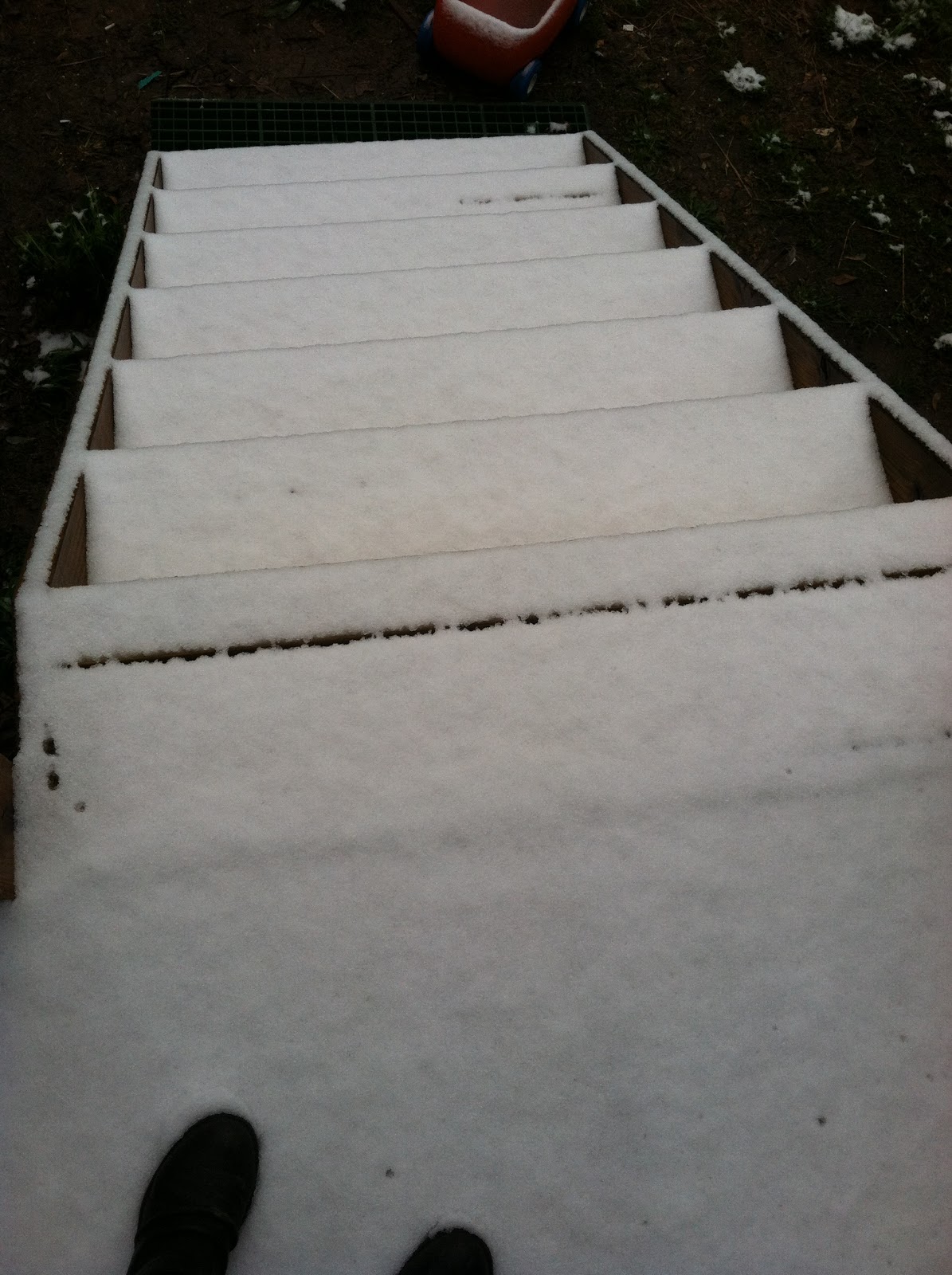
     Wednesday it snowed. Before the rain stopped, the temperature dropped dramatically and flurries fell. The warm ground melted the flakes almost instantly but the contrast was shocking. I wonder where those little frogs are now, on this cold night. Hopefully they fled beneath the ground and buried themselves in the mud before the earth froze again. With such a short and mild winter, I have to wonder if the Ozarks will be ready for an early spring.

Tuesday, January 22, 2013

Visiting the Farm

Mother sheep and twins still crusty with afterbirth
     A bitterly cold winter night in January is birthing time on my uncle's farm. His sheep seem to aways give birth at night and often during the cold months of late winter or very early spring. During the last cold snap, triplets were born. Some sheep are more inclined to birth one lamb, others birth twins most often, and some ewes will birth triplets. Though my uncle's sheep usually have one or two babies, he does not see triplets very often. Even more rarely do they all live.
     It is especially hard to keep lambs alive on cold winter nights. They arrive wet in a cold world and though their mother licks them dry, the cold wind can kill them, especially the one who is licked dry last. It seems counter intuitive to birth a lamb on a cold winter night, but perhaps it comes from a fear of something much more dangerous than the cold, like wolves. Predators are less likely to be out on the prowl if the weather is fowl, so the sheep brave the cold to give their babies a head start.
Less than a day old lamb
     It doesn't take long for lambs to start frolicking in the fields. When born at night, they are usually fairly sturdy on their feet by noon. Within a day, they are hard to catch. It is important for lambs to run from predators as soon as possible. Sometimes it makes me wonder how human babies survive, being so helpless for so long.
     Last weekend, the weather in the Ozarks was as perfect as it gets on a January day. The sun shone bright in the cloudless sky and the lite breeze blew warm air over the hills. I decided it was a perfect day to escape the confinements of the city and explore the countryside. My uncle invited us out to his farm, where the lamb triplets were only three days old.
     My three year old son was delighted as usual by the innocence on the baby lambs. He laughs when he sees them run with a glee that he only achive outside. We managed to catch one and he gently pet its tiny head while I held it. We talked about the baby with enthusiasim. He has been facinated with babies ever since my pregnant belly began to grow.
Curious young cow
The cows make him smile too. He wanted to feed them grass from the other side of the fence. Though they ventured much closer to him--being only a few feet tall--then they would to us, they were not brave enough to eat out of his hand. I see cows every day while driving, from a far. But I forget how big they are until I am standing next to one. Despite their size, they are gentle and easily spooked.
     Most days we collect eggs from the chicken house and feed the koi fish in my aunt's fish pond. Sitting on the tractor and pretending to drive is also fun, but no as exciting as riding on my uncle's solar powered golf cart. Zane was even allowed to steer the golf car all by himself.
     Though the day was beautiful, it was also short. As the sun set, the cool winter temperatures crept under our skin. I know my son enjoyed his day at the farm, but perhaps not as much as I enjoy seeing him there. So often he has his head buried in a book or his eyes are glued to a screen. I wish he could spend more days herding sheep, collecting eggs, and feeding fish. Perhaps we will have our own farm one day soon. For now, I will just keep exposing him to the country side as much as I can.