About Me

My photo
I am a mother, a teacher, and a nature lover. I grew up on a mountain we called Owls' Knob in the Ozarks of Arkansas. The first seven years of my life were spent living in a log cabin, far from a store or streetlight, without electricity or running water and after twenty years of travel, I returned to the abondoned homestead. Now I live on a hill by a small lake and work at a public garden. These are stories about nature written from a women deeply influenced by place.
Showing posts with label gardening. Show all posts

Wednesday, July 10, 2013

Inscets in the Garden

Squash Bug Nymphs
In the garden there are two types of insects: herbivores and carnivores.
In the garden (unlike the jungle) the herbivores are your enemies and the carnivores are your friends.
The cute little inch worm caterpillar, inching along the leaf , will devastate your garden but the wasp, who you so desperately wanted to die, is actually in the garden to eat that inch worm. The wasp is a friend to the garden. Spiders building webs among the rows of peas are welcome. While the lovely white butterfly frolicking from cabbage plant to broccoli plant is laying eggs which will hatch into hungry caterpillars.

Tomato hornworm
But it is not that easy; it is not black and white. The wasp will protect you plants but might sting you if are poking around the backside of a cabbage head. The caterpillars will eat the cabbage, metamorphose into a butterfly, and pollinate the blossoms on the apple tree. In one stage of its life it is your enemy, but in another is a friend. The relationship is complex; it is not cut and dry.
This year I tended the garden with vigor. I spent evenings picking caterpillars and eggs off cabbage and broccoli leaves. The red wasps and I learned to avoid each other directly. We were after the same insect and there were plenty for both of us. But alas, I hardly got a single cabbage from the patch.
Now I am checking the under side of zucchini leaves for squash bug eggs and squishing every squash bug I see. It is brutal. My hands are stained green and brown with insect blood. The stench of dead and crushed exoskeletons haunts me. I do not enjoy it. But it must be done if I want to feed my family. Distance helps the process. I have begun using an organic spray. I mix three tablespoons of dish soap into a gallon of water. I put the water in a spray bottle and attack the plants. The dish soap and water solution kills aphids and squash bugs. But what else does it kill? The spray is to be used sparingly, with caution. (To learn more about this natural insecticide visit my blog A Simply Natural Home.)

Ladybug Nymph
I have found my two favorite garden insects in the garden recently: the lady bug and the praying mantis. These are both carnivores and eat the other insects in the garden. I have also seen many different species of spiders and of course wasps. All of these insects prey upon the insects that chow down on my squash, corn, and tomatoes.
I picked the first tomato of the season a few days ago. I pick tomatoes as they begin to turn yellow and pink. I find that if I wait until they are red, something will have already taken the first bite. I let the tomato ripen in the fruit basket on the kitchen table. Today I picked it up to find a small hole in the top of the tomato. I looked down inside and saw a green caterpillar, eating away. I showed my son the tomato and my husband took some pictures (I will add them later). We passed the tomato back and forth as the caterpillar poked his head out and then retreated back inside to eat some more. My three year old was delighted by this game of peek-a-boo. I opened the tomato carefully and examined the home that caterpillar had made inside the fruit I had grown.
My husband took the caterpillar out of the tomato and laid it on the table. The tiny creature looked afraid, alone, and helpless, stranded on a vast empty table.
Somehow, in this context, I could not kill him. I claimed the good parts of the tomato. I cut off the spots that were half eaten and threw the pieces as well as the caterpillar into the compost. I dumped the compost in the pile. The caterpillar might survive, he might not. My husband exclaimed, "Kill the thief!" And I had to agree, he was a thief, but just a hungry one trying to eat what he believe were simply the free fruits of the earth. He did not know it was MY garden. So I could not bring myself to kill him. Not after seeing him so helpless on my table. Not after he played peek-a-boo with my son.  I just kept thinking of the lovely butterfly the caterpillar would become if I let him live.


Young Praying Mantis

Saturday, May 4, 2013

Snow in May in the South

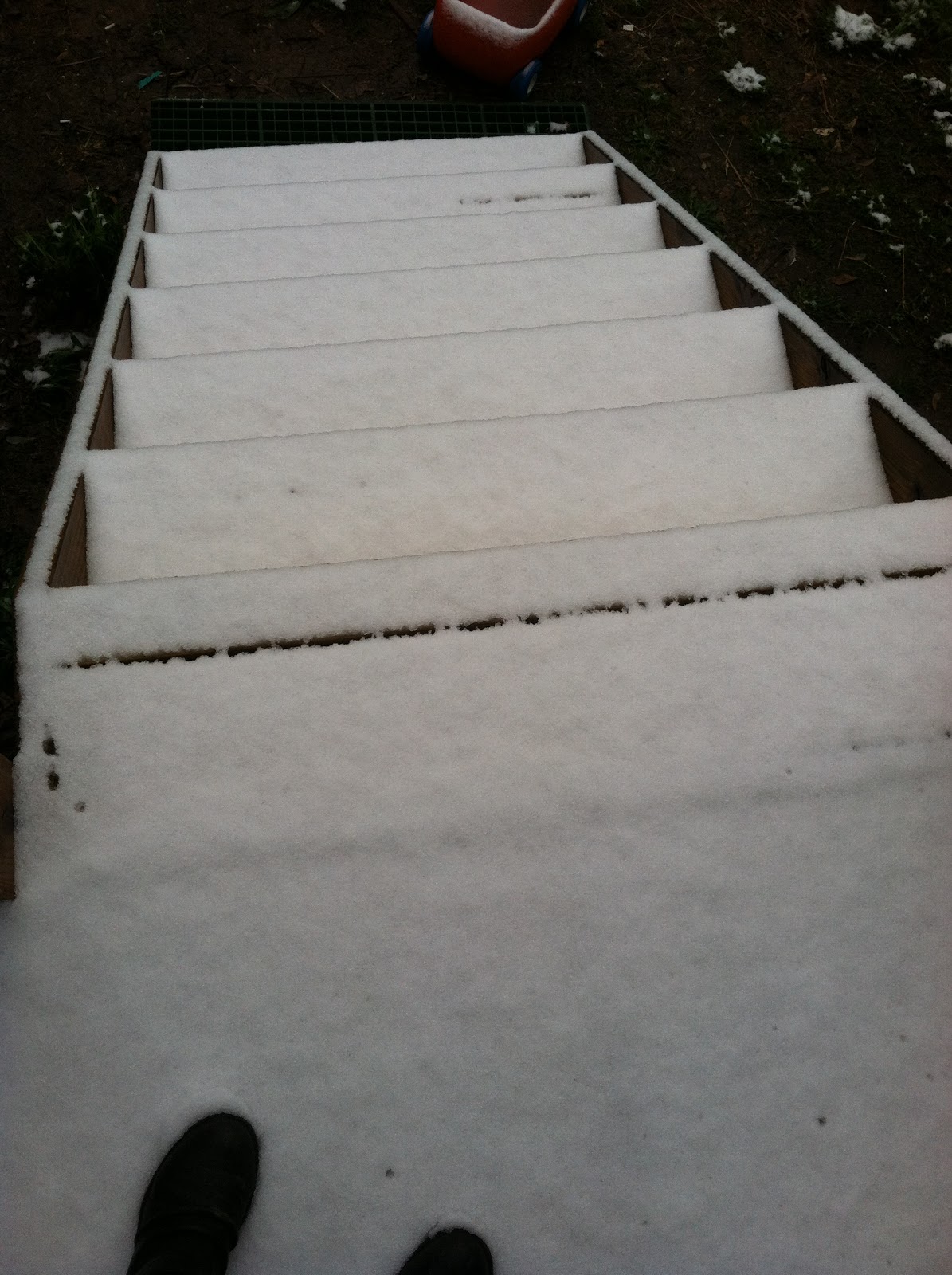
I think the term global warming has done a huge amount of damage to the envormentalist movement against climate change. The term climate change much better captures what we are experiencing. We are not just seeing hotter summers and more mild winters, but droughts, floods, cold snaps out of season, and heat waves out of place. Wednesday afternoon the temperature reached into the upper 80s, Thursday night it dropped to below freezing! It even snowed!


I enjoy a nice snow in January. But once the irises have bloomed, peach blossums have dropped, and lettuce is popping up, I do not wish to see any snow! The biggest problem with climate change, of any kind, is its affects on gardens and food production. We may not like seeing snow in May or dangerous heat waves in August, but our comfort is not an issue. However, if lettuce is frozen and dies in May and beans can not survive the heat and drought, what will we all eat!


In my garden, I avoid planting anything that is not freeze tolerant until after April 15th. In the past that seems to be a safe date to start assuming the freezing tempertures are behind us. By May we are often hoping the plants don't go to seed too early in the heat. Frost has never been an issue this late in the season in my lifetime. I had plenty of plants in my garden that would not tolerate the snow. Luckily, I watched the weather and knew the cold front was on its way. In fact, the weather application on my husbands phone woke me up several times throughout the night beeping and alerting me to the freeze watch that was in effect. Most of the plants I have above ground are tolerant to a light freeze, but I needed to covered my tomatoes, peppers, and delicate leafy greens.


This year I found a simple, cheap, and effective way to cover my vegetables. I built temporary, miniature hoop houses. I used a roll of thick old wire that had been sitting under leaves in my father's back yard. I cut my wire in big half circles (or more like 3/4 circles), their shape was already perfect for my minutes hoop house. I took the pieces of wire and poked the ends into the ground on either side of the garden bed. I could have bought clear plastic to cover the hoop houses, but instead I tried just using old bedsheets, since I had them lying around already. All season I left the hoops bridging the beds and just threw the sheets over them when there was a chance of a freeze. It was much easier than I would have thought and cost me nothing. Most importantly, it saved my little plants!
 
Do you have a garden?
How did it do in this unseasonably cold front?
Share your ideas for protecting your garden against spring frosts!

Friday, April 13, 2012

Peach Tree Update

When I bought my house last May, I had very little hope for the three peach trees that were in the back yard. They looked half dead, with more braches rotting than growing! But during the winter I cut all the dead wood away. I didn't actually "prune" any live branches because once I had cut away the dead wood there wasn't much of a tree left to cut on! So I mulched with leaves, watered, and waited...


Sure enough, the trees bloomed and small peaches are forming where the petals fell away. At first there were half a dozen fruits trying to grow on every tiny twig. So I pruned most of them, leaving only one peach on each branch. This way maybe the tree will have enough energy to make a few edible peaches instead of working hard to make a bunch a scrawny ones. I haven't gotten a peach yet, but I have high hopes that these trees will live and florish to produce peaches for many season to come!

Monday, March 5, 2012

How Do I Prune Neglected Peach and Pear Trees?

Peach Buds Blooming

Pear Tree in need of attention
Neglected Pear Tree
When we bought the house in Fayetteville, a selling point for me were the five neglected fruit trees out back. I suddenly owned five fruit trees, one pear, one cherry, and three peach trees. I didn't think about the fact that I knew nothing about caring for fruit trees.  I read that the cherry might be just fine with or without my care. Apparently cherries don't need a lot of pruning. So I have done nothing to that old tree.
Ozark pears trees are hearty and live a long time; however, this pear tree is a massive mess of branches all clustered together. All the branches shoot up, few branch out. I am not sure how to approach it. Should I cut most of these clustered branches? I don't want to cut too many. Please leave comments below if you have any ideas.
After a particularly harsh summer, with long droughts and high heat, the peach trees were near death. I gave them water to keep them alive in late summer. I also mulched the soil around them heavily in fall with good topsoil and leaves. I read a few different chapters from various books on pruning fruit trees. Basically, I take it that peaches need lots of pruning, don't live or produce fruit for long, and are not hearty. These poor trees might be a lost cause; nevertheless, I am giving it a shot.
Wire cutters for pruning
Peach Tree after pruning dead wood
Before spring began to make the peach buds blossom, I went out with a pair of dull pruning shears, a saw, and a pair a wire cutters. The wire cutters gave me the cleanest cut. I began by just cutting away the dead wood. The more I cut, the more I realized that just pruning the dead wood was going to cut the peach tree down to size. It seems like the peach tree pruned itself, killing off the wood that needed to go. But now that most of the branches are gone, the peach trees are not in the right shape. Still, if I cut more they won't have any branches left. I really don't know if the peach trees will survive. If they do, I doubt that they will produce fruit. Nevertheless, they are blooming and beautiful right now!

If anyone out there knows any tips about bringing back neglected fruit trees please leave a comment!

Sunday, January 29, 2012

Bean Mountain Farm Plants


Winter strips the leaves off trees and turns the grass from green to brown. Gardens are mostly barren. Only the most hardy plants remain.
At owls knob, even without water this summer or any attention during fall or winter, a few plants seem to always persist. Kale is the main vegetable. I posted back in fall about how kale is an amazing food. It grows despite drought and even keeps producing green edible leaves through most winters. This year has been mild so far and my kale is still flourishing. I was delighted to pick delectable fresh greens to spice up my burrito last weekend!
Herbs also persevere through the winter months. I once had an old rosemary bush that lived five years and produced food all winter. I also had an old thyme plant that kept  its leaves in the snow and ice. Though they died back each cold season, it grew bigger than ever before each spring.
This year oregano is my herb. Underneath the blown leaves I find hairy oregano leaves hiding. It is nice to flavor pasta with fresh oregano in January!
But I can not take credit for these herbs and hardy vegetables. The plants I grow from seed rarely last long, grow big, or produce in hard seasons. The plants in my garden that thrive are all from Bean Mountain Farm.
Bean Mountain Farm sell small and large plant starts every spring. They always have a booth outside the Ozark Nature Food Co-op on different weekends in spring. This year some of their sale dates are March 24, April 14 (Owner Appreciation Weekend) and May 12, all at ONF. Their annual Mother's Day Sale always inspires me to finish planting before the cool spring weather expires. I have bought plants from the Walmart plant department or from Lowes with much less success. Often the plants I buy from these big stores are half the price as local plants. But when the plants dies and all my money is lost I realize that investing in quality plants is very important! Something about the Bean Mountain Farm plants is special. They live a long time, grow bigger, and are very hardy. When preparing your garden this year, consider buying your plants from a local farmer!

Saturday, November 5, 2011

Food and Water

   The garden at Owl's Knob, which has been neglected, is still producing kale. The leafy vegetable doesn't mind a light freeze and can almost grow year round. Though it's leaves will become skeletal in summer as Japanese beetles feast on them, they regain their composure in fall and leaf out again. It is an easy crop to grow in sun or partial shade and it doesn't mind a drought or heavy rain. I would say that kale is the ultimate apocalypse vegetable!
    But how do you eat it? Though I like snacking on its leaves raw or adding baby leaves to a salad, not everyone likes the strong flavor. Kale is great steamed along with other sweeter vegetables like squash or carrot. But my favorite way to cook kale is to saute it with soy sauce and oil or butter. This can be done in a stir-fry or by itself. Either way, it is important to not burn the kale leaves. To prevent burning you can add a splash of water, wine, or soy sauce. Keep the vegetables steaming more then frying.


The well at Owl's Knob, in which the water is 100 feet underground, is not functioning. Either the 12 volt pump is clogged, or the water table dropped. But the system is not working. However, the spring in the holler is still flowing. All throughout my life I have been drinking from this spring. At ONSC I ask children if water coming straight out of the ground, spring water, is clean. They always say no. When I tell them that the typical backpacking water filter uses clay to filter river-water, they are puzzled. But only then do they accept that the water, filtered by the clay in the ground, might be clean.
    Deep in a gully there is a mossy spring, shaded by maiden-hair ferns and old magnolia trees. The water comes trickling out of the bedrock, flowing over a slab of limestone and dropping into a sink hole that leads to Terrapin Creek, a tributary to the headwaters of the Buffalo river.
    To retrieve water from the trickle that hugs the bedrock, you must take a leaf and a rock. The leaf is placed in the stream of water with its steam hanging just over the bedrock's ledge. Then the rock is placed on top of the leaf to keep it in place. Thus, a spout is created, and the trickle of water, seeping over the stones, is launched into my jug.
Patiently, I wait for the gallon to fill.
It is like waiting for kale to grow.
Slowly but surely, nature provides.

Thursday, May 5, 2011

Perfect Planting Day

In years past I have grown a lousy garden. But it wasn’t entirely my fault, though I seem to lack a green thumb. My soil was hard packed, weeds crept in from every angle, trees blocked out the sunlight, and I had no big tools to help me. This year John abolished my excuses. He cut about six hickories which blocked the morning sunlight and tilled the soil until it turned like soft packed brown sugar. My garden beds are weed free, rock free, and bright. The sunlit soil is rich from years of leaves, organic mulch, accumulating on the forest floor. If my garden does not flourish this year I have only myself and the weather to blame. Until recently the weather has been against me.
Before I could really start planting those awful April floods began. As soon as the last chance for a late frost had passed, the rain began and it didn’t lift until May. The saturated soil refused to hold more liquid so flooding began. I felt fortunate to live on a mountain top. Still, even up here the earth would not accept my seeds and everything I had planted early washed away or drowned.
However, today was the perfect planting day. The mud had begun to regain its composure but still held moisture. I put everything in the ground today, all at once. I started with peas because that is the first thing I always plant, but in March, not May. So before I put them in the ground I soaked them for about 48 hours, letting them sprout a bit. (That tip came to me from the awesome book Carla Emery's Old Fashion Recipe Book: An Encyclopedia of Country Living.) Hopefully this will give them a jump start and they can beat the heat that kills them off every summer.
Then I leap to cucumbers, lining them up along a fence with the peas. I erected a simple tee-pee type trellis and planted pole beans and squash below it. In the center of the garden, I set tomato starts into the dark earth. Beets, collards, kale, chard, and sunflowers also began their lives on this beautiful day. As I worked, an indigo bunting serenaded me with its lovely melody. 
A little ways from the garden, along the edge if the driveway, I formed a flower bed. Zane followed me out to it and I gave him a three pronged hand-tool. He dug the prepared surface. Then I let him take as few seeds from my pouch. I told him to "Sprinkle, sprinkle." He did just that while chanting "spky, spky." Then Zane scratched the seeded soil again to burry the flowers. Finally, we gave the ground little "pat, pats." It amazes me how natural gardening is to a child.  
Once I had finished putting all my seeds in the ground, the sun subsided and rain clouds moved in. As the day came to a close I didn’t have to water my freshly planted beds, the sky showered them, just enough but not too much. I have hope for my garden this year.